

Content by: Wendy Busse-Coleman | BLOG | The Back Page | 3 Minute Read | September 2, 2026
How scammers are cloning car dealers online, and why "it looks legitimate" is no longer enough
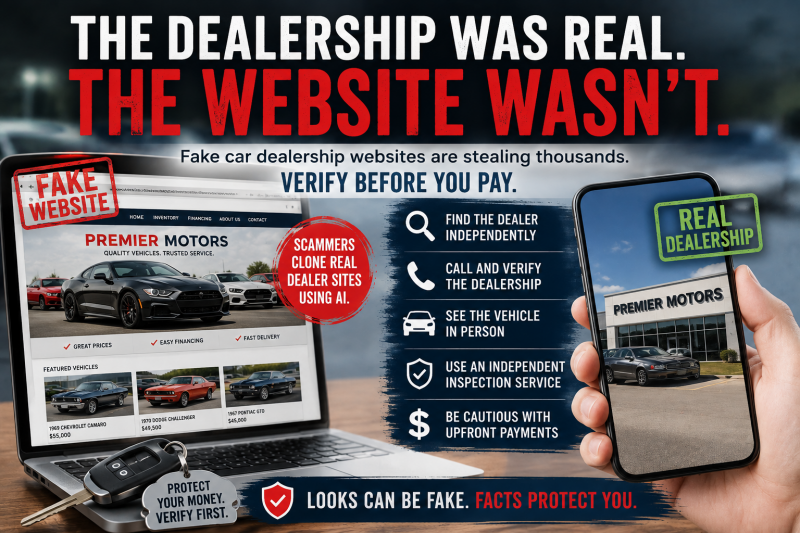
Picture this.
You have been looking for a particular car for weeks.
Maybe it is a hard-to-find classic. Maybe it is simply the right make, model, color and price.
Then one evening, there it is.
You find a dealership website that looks completely legitimate.
The logo is there.
The inventory looks real.
The photos look professional.
There are customer testimonials, financing information, return policies and detailed descriptions of how the buying process works.
You may even recognize the name of the dealership.
So you call.
You make arrangements.
You send the payment.
Then you arrive to pick up the car.
And the real dealership has no idea who you are.
No order.
No payment.
No car waiting for you.
So, here’s the scoop from the Federal Trade Commission (FTC) on September 1, 2026. Scammers are up to no good, making fake car dealership websites that look super legit some are even copying the real ones down to the last detail! The FTC mentioned that these tricksters are using artificial intelligence to mimic branding, vehicle listings, photos, and all the other stuff that makes these sites seem real. Watch out!
And that is what makes this one worth talking about.
The Website Can Be Fake Even When the Dealership Is Real
This is an important distinction.
A you may search the name of the dealership and discover that yes, the business really exists.
There may be years of positive reviews.
There may be a legitimate physical location.
The dealer may have an established history.
All of that can be true.
And you can still be talking to a scammer.
Why?
Because the criminal may be impersonating the real business.
The scammer does not have to invent credibility from scratch. They borrow someone else's.
That is becoming an increasingly important consumer lesson.
A real company name does not automatically make the website in front of you real.
“But It Looked So Professional”
I think this is where many of us need to update our thinking.
We have been told for years to look for obvious warning signs:
- Bad spelling.
- Awkward grammar.
- Cheap-looking websites.
- Strange logos.
- Pages that do not work.
All still useful.
But they are no longer enough.
Today, scammers have access to better design tools, copied website templates and increasingly capable artificial intelligence.
A fake website can look polished.
According to the FTC, some of these bogus dealership sites include fake customer testimonials, descriptions of the purchasing process and flexible return policies specifically designed to put shoppers at ease.
In other words, the parts of the website that make you think:
“This looks legitimate.”
may be there specifically because someone wants you to think exactly that.
Rare Cars Make Particularly Good Bait
The FTC says scammers may advertise rare muscle cars or difficult-to-find classics.
That makes sense when you think about the psychology.
If you have spent months searching for one particular car and suddenly find it, there is already pressure.
Someone else could buy it.
The price looks good.
You do not want to lose your chance.
That excitement can shorten the amount of time we spend verifying what is in front of us.
And scammers love urgency.
It is the same ingredient we see again and again in fraud.
- Act now.
- Pay now.
- Someone else is interested.
- We cannot hold it without a deposit.
The product changes. The pressure does not.
Here Is the Most Important Rule
If you take only one thing from this article, make it this:
Never verify a business using only the contact information provided by the business you are trying to verify.
That sounds almost obvious when written out.
But think about what happens in practice.
You find a dealership website.
You wonder whether it is legitimate.
So, you call the telephone number on that website.
The person answers professionally and confirms everything.
But if the website is fake, you have just asked the scammer to verify the scammer.
Instead, create a second path back to the business.
Look up the dealership through an independent source.
Find its official business listing.
Check the manufacturer's dealer directory if it is a franchised dealership.
Look for state licensing information.
Find another established source for the dealership's telephone number.
Then call and ask:
- “Is this your website?”
- “Is this vehicle actually in your inventory?”
- “Am I dealing with one of your employees?”
Those few questions could save thousands of dollars.
Ask to See the Car
The FTC offers another beautifully simple piece of advice:
- Ask to see the vehicle and dealership in person.
If you are purchasing from across the country, that may not be practical. Fine.
Hire an independent mobile inspection company to look at the vehicle for you.
If the seller refuses to allow an independent inspection, the FTC says that is a reason to consider taking your business elsewhere.
That is a powerful verification step because now someone who you selected is physically confirming that the car exists where the seller says it exists.
Be Especially Careful With Wire Transfers
Wire transfers deserve their own warning.
The FTC specifically says to walk away if the seller insists on upfront payment by wire transfer only.
Why?
Because wire transfers can be extremely difficult to reverse after the money is sent.
That does not mean every business accepting a wire transfer is fraudulent.
Large legitimate purchases sometimes involve them.
But if you are dealing with a company, you have never personally verified, and someone is pressuring you to wire tens of thousands of dollars before you have independently confirmed the vehicle?
That is the moment to stop. Excitement can wait. Verification comes first.
Search for the Dealer, But Do Not Stop There
The FTC recommends searching the dealer's name along with words such as:
- scam
- review
- complaint
That is a good first step.
But there is an interesting catch.
If the scammer is impersonating a real dealership, your search may return excellent reviews.
Those reviews may genuinely belong to the real company.
They do not necessarily authenticate the website you are currently visiting.
That is why independent contact matters so much.
The question is not simply:
“Is this dealership legitimate?”
The question is:
“Am I actually dealing with that dealership?”
Very different question.
A Voices for Safety Car-Buying Check
Before sending money for a vehicle you found online:

And perhaps most importantly:
Be cautious about payment pressure. Especially demands for an immediate wire transfer; and
Do not let the fear of losing a great deal make you lose your money instead.
Looking Legitimate Is No Longer Verification
This story is about cars, but I think the larger lesson goes much further.
- Fake vacation rentals can copy real properties.
- Fake contractors can copy real company information.
- Fake online stores can reproduce legitimate product photographs.
- Fake charities can imitate established organizations.
- Fake financial services can borrow the names and branding of real institutions.
And now artificial intelligence makes reproducing that credibility easier.
So our verification habits have to change.
We cannot rely entirely on appearance.
A beautiful website proves someone knows how to make a beautiful website. It does not necessarily prove who made it.
The Small Pause That Matters
Buying a car is exciting.
Finding the one you wanted at the right price is even more exciting.
I understand the temptation to move quickly.
But before sending a deposit or payment, create that second path.
- Close the website.
- Find the dealership independently.
- Make the call.
- Verify the car.
- Then proceed.
Five or ten minutes of extra checking is a very small inconvenience compared with discovering that tens of thousands of dollars went to someone who never owned the vehicle in the first place.
At Voices for Safety, we talk a lot about slowing down long enough to verify what is in front of us.
This is another perfect example.
The dealership may be real.
The car may be real.
The photographs may even be real.
But you still have to verify that the person asking for your money is real.
Looking legitimate is no longer enough. Verify first. Pay second.
Add comment
Comments