

Content by Wendy Busse-Coleman | Consumer-Protection Advocate and Author, Founder of Voices for Safety, Subscription Watch, and Clear Terms Press/Acorn Gold Press | I write about subscription traps, dark patterns, the fine print few people read, and inspired by my granddaughter, short bedtime stories.
I'll be honest with you. A few days ago, I had never heard of kratom.
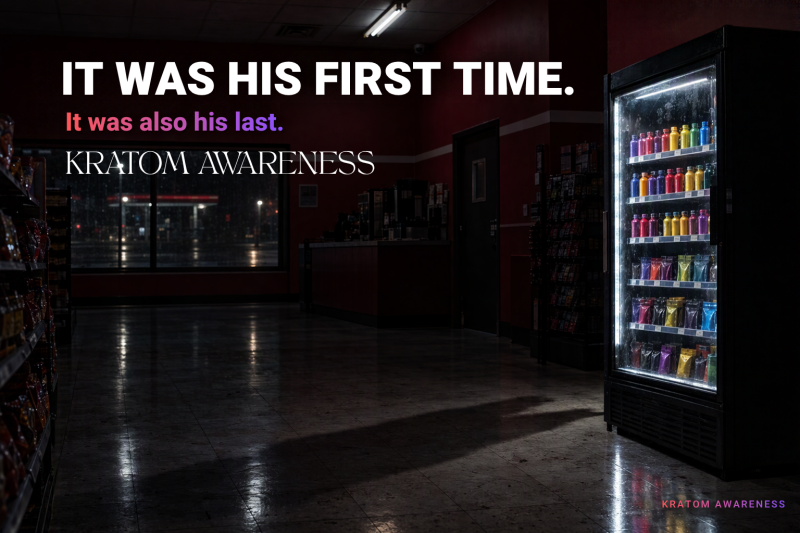
Then I was scrolling on Instagram and came across an interview with two mothers. Both had lost their sons to this drug. One son was 27 and died four years ago. The other was 20 and died just a few months. What stopped me cold was that the 20-year-old bought it from a vending machine, and it was his very first time trying it.
I couldn’t stop thinking about it: a vending machine. You know, the kind we walk past every day to grab a soda or a bag of chips. So, I started looking into it, and I want to share what I found because I don’t think most of us realize this is happening.
What is Kratom?
Kratom comes from the leaves of a tree native to Southeast Asia. It's sold as powders, capsules, gummies, drinks, and "wellness shots," often in gas stations, smoke shops, and yes, vending machines. The packaging can look as harmless as an energy drink.
But kratom affects the same part of the brain that opioids do. Newer concentrated versions, especially products called "7-OH," are far stronger than the plant itself. The people buying them often have no idea what they're actually taking.
People are Dying
The CDC found that kratom was involved in 846 overdose deaths in one year (2022). That figure includes data from only 30 states and Washington, D.C., so the actual number is likely higher. California’s health department connected kratom to 242 deaths between 2020 and 2022. In Los Angeles County, officials also reported deaths among otherwise healthy young adults, with no other substances found to have substantially contributed to their deaths.
Every one of those numbers was somebody's son, daughter, brother, or friend. Two of them were the boys whose mothers I watched on that video.
How is this Even Legal?
That was my question, too. The answer is that it depends on where you live.
- Federally, kratom isn't banned. The DEA has only recently started moving against some of the strongest 7-OH compounds.
- In California, the state says it's illegal to sell kratom or 7-OH for human consumption at any age, and officials have pulled thousands of products off shelves.
- In Maryland, it's legal but regulated. Buyers must be 21 or older, and there are limits on potency and labeling rules. But think about a vending machine for a minute. Who checks the ID?
A patchwork of laws means a young person in one state is protected, while a young person a few hours away can buy it with pocket change and no questions asked.
Why I'm Writing This
I'm not a doctor or a lawmaker. I'm just someone who watched two mothers talk about the worst day of their lives and thought: this can't keep happening.
A 20-year-old trying something once shouldn't cost him his life. A product sold next to snacks shouldn't be able to kill someone.
What You Can Do
- Talk about it. Tell your kids, grandkids, nieces, nephews, and friends what kratom is. Many young people think it's a harmless "natural" supplement.
- Look around. Notice whether kratom is sold in vending machines, gas stations, or shops near you, especially near schools and colleges.
- Contact your state legislators. Ask them to support banning kratom sales from vending machines, enforcing age limits, and getting high-potency products off the market.
- Share this post. Awareness is how change starts. Those mothers spoke up so other families wouldn't have to go through what they did. The least I can do is help carry their message.
If you or someone you love is struggling with kratom or any substance, please reach out. In the U.S., you can call the free, confidential SAMHSA National Helpline at 1-800-662-4357, any time. If someone may be overdosing, call 911 right away. For questions about possible poisoning, call Poison Control at 1-800-222-1222.
It was his first time. Let's make sure no other family has to say those words.
— Wendy
Sources:
-
California Governor's Office, "Governor Newsom announces 95% compliance with prohibition of illegal kratom products" (March 3, 2026): https://www.gov.ca.gov/2026/03/03/governor-newsom-announces-95-compliance-with-prohibition-of-illegal-kratom-products/ (CDC 2022 figure, California 2020–2022 deaths, Los Angeles County cases)
-
California Department of Public Health, "Prohibition on the Sale of Kratom and 7-OH Products" (January 9, 2026): https://www.cdph.ca.gov/Programs/CEH/DFDCS/CDPH%20Document%20Library/FDB/FoodSafetyProgram/KratomLetterTobaccoRetailers.pdf
-
California Governor's Office, enforcement update (September 2, 2026): https://www.gov.ca.gov/2026/09/02/governor-newsom-announces-nearly-15300-illegal-hemp-kratom-and-7-oh-products-removed-from-california-store-shelves/
-
Maryland General Assembly, Health–General § 21-2E-02: https://mgaleg.maryland.gov/2026RS/Statute_Web/ghg/21-2E-02.pdf
-
Maryland Alcohol, Tobacco, and Cannabis Commission, "Know the Rules: Selling Kratom, Phenibut, or Tianeptine Products" (rev. July 31, 2026): https://content.govdelivery.com/attachments/MDATCC/2026/08/03/file_attachments/3733798/ATCC-Know-The-Rules-KRATOM.pdf
-
SAMHSA National Helpline: https://www.samhsa.gov/find-help/national-helpline
Add comment
Comments