

Content by Wendy Busse-Coleman | Consumer-Protection Advocate and author, founder of Voices for Safety, Subscription Watch, and Clear Terms Press/Acorn Gold Press | I write about subscription traps, dark patterns, the fine print few people read, and, inspired by my granddaughter, short bedtime stories.
The Back Page | Blog | 3 Minute Read | November 24, 2026
When I first saw headlines announcing that New York City was ending its horse-drawn carriage industry, I had the same question I suspect a lot of people had: Does this mean the carriages are stopping now?
The answer is no.
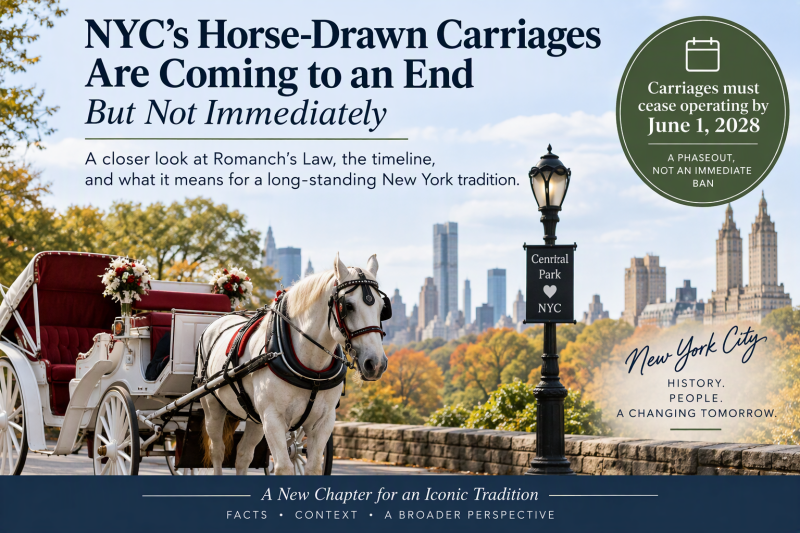
Mayor Zohran Mamdani signed Romanch’s Law on November 19, 2026, ending a New York City tradition that has existed for more than 150 years. But this is not an immediate cease-and-desist order. Horse-drawn carriages have until June 1, 2028, to cease operating on New York City streets. [nyc.gov]
That distinction matters, particularly when headlines can make something sound as though it happened overnight.
Why Is It Called Romanch's Law?
The law is named for Romanch Mahajan, an 18-year-old who died following a horse-drawn carriage accident in Central Park on June 17, 2026. His death became a catalyst for the legislation. [nyc.gov]
According to the New York City Council, horse-drawn carriages have operated in Central Park since 1858, beginning as transportation and later becoming the tourist attraction generations of New Yorkers and visitors came to recognize. [council.nyc.gov]
That is a remarkable amount of history.
For many people, myself included, there is something sad about seeing such a longstanding piece of New York City history come to an end. Images of horses pulling carriages through Central Park are almost inseparable from the image many of us have of New York.
But recognizing that history doesn't mean ignoring what happened to Romanch Mahajan, or the concerns that have been raised about public safety and the welfare of the horses.
Both things can be true at the same time.
We can acknowledge a tragic loss of life and the need to address safety while also feeling a sense of loss over the end of a tradition that has been part of New York City for generations.
This Is a Phaseout, Not an Overnight Ban
This is where I think some of the reporting deserves a closer look.
Saying New York City has“banned horse-drawn carriages” isn't necessarily wrong. But without mentioning the effective date, it can leave readers with the impression that the carriages are already gone.
They're not.
The City Council described Romanch's Law as legislation that will phase out the industry. Under the law, horse-drawn carriage operations are to end by June 1, 2028. [council.nyc.gov]
That phaseout also serves another purpose. There are real people whose livelihoods depend on this industry.
The law requires the administration to establish a workforce-transition program for carriage drivers and other workers. The City Council says that assistance is to include employment referrals, career counseling, hiring fairs and identification of educational opportunities. The administration is also to consider compensation involving carriage businesses, licenses and equipment. [council.nyc.gov]
The Mayor's Office says approximately 200 workers will be affected and has announced plans involving medallion buybacks, career services and workforce development. [nyc.gov]
The horses are part of the transition as well. The City Council says the legislation includes protections intended to prevent retired carriage horses from being subjected to inhumane treatment or disposition. [council.nyc.gov]
Sometimes the Headline Isn't the Whole Story
This is one of those stories where a few extra words make a big difference.
“New York City bans horse-drawn carriages”
and
“New York City will phase out horse-drawn carriages by June 2028”
give readers very different impressions.
The second provides the context.
New York City has made its decision. The era of horse-drawn carriage rides is coming to an end.
But it didn't end the day Mayor Zohran Mamdani signed Romanch's Law.
There is a transition period for the horses, the drivers, the stable workers and the businesses that have been part of this industry. And there is time for New York to say goodbye to something that, whether you supported it or opposed it, has been woven into the history and imagery of Central Park for generations.
I find that part bittersweet.
What happened to Romanch Mahajan was tragic, and his death should not be minimized when discussing why this legislation moved forward. At the same time, I think it is possible to recognize the significance of the safety and animal-welfare concerns while also acknowledging what New York City is losing.
After more than a century and a half, another familiar part of old New York is gradually passing into history.
And that is the part of the story a headline alone may not tell you.
Sources
-
New York City Mayor's Office, November 19, 2026: announcement of the signing of Romanch's Law and the June 1, 2028 phaseout date. [nyc.gov]
-
New York City Council, October 22, 2026: history of the carriage industry and explanation of the phaseout. [council.nyc.gov]
-
New York City Council, October 22, 2026: worker-transition and horse-protection provisions. [council.nyc.gov]
Add comment
Comments