

Content by: Wendy Busse-Coleman | BLOG | The Back Page | 2 Minute Read | September 1, 2026
"Is this really the best value, or simply the product I saw first?"
What Really Happens When You Search for a Product on Amazon
You need a new coffee maker.
Nothing fancy. Maybe the one you have finally made that last sad cup of coffee and decided it was officially done.
So, you do what millions of us do.
You open Amazon.
You type "coffee maker" into the search box.
And there they are.
Rows of choices.

Made with Canva AI
One has thousands of reviews. Another has a bright read discount. One promises delivery tomorrow.
And right near the top are several products that seem to be exactly what you were searching for. You may assume Amazon's search system has decided those products are the best matches.
Maybe they are.
But there's something else you should notice. Look closely and you may see a small word:
Sponsored.
That one little word changes the story.
Because some of the products appearing prominently in your Amazon search results aren't there simply because Amazon's system determined they were the best products for you.
Advertisers paid for the opportunity to appear there.
And now the Federal Trade Commission (FTC) and 22 states are challenging what allegedly happened behind the scenes when Amazon decided how much those advertisers had to pay.
This may sound like a dispute between Amazon and its advertisers. It isn't that simple.
Because when the cost of selling something goes up, eventually consumers need to ask:
Who ultimately pays for it?
What the FTC Says Happened
On August 31, 2026, the FTC and attorneys general from 22 states filed a lawsuit against Amazon over its advertising auction practices.
The FTC alleges Amazon secretly changed the way certain advertising auctions operated and substantially increased what advertisers paid to place Sponsored Products, Sponsored Brands and display ads on Amazon.
According to the complaint, more than one million brands and sellers advertised through these systems, including more than 500,000 small and midsize businesses.
The FTC alleges the practices generated tens of billions of dollars in additional revenue for Amazon.
Those are significant allegations.
And that's exactly what they are right now: allegations contained in a lawsuit.
Amazon disputes them.
The case is pending, and a court has not determined that Amazon violated the law.
That distinction matters.
But what this lawsuit shows about the stuff that makes the products we use every day tick is pretty interesting to know.
First, What Exactly Is an Amazon Sponsored Product?
Let's take our coffee maker again.
Imagine five companies sell coffee makers and all five would love their product to appear at the top of your Amazon search.
Amazon gives sellers an opportunity to advertise.
They bid for advertising placement connected to searches such as:
coffee maker
or
12-cup coffee maker
or perhaps
programmable coffee maker
When someone searches using those words, Amazon determines which sponsored advertisements appear.
It's similar to advertising on a search engine.
The consumer doesn't pay Amazon for the advertisement.
The seller does.
But advertising is still a cost of doing business.
And businesses have to account for those costs somewhere.
That is where this becomes a consumer story.
Here's Where the Auction Gets Interesting
Stay with me because the phrase "second-price auction" sounds considerably more complicated than it actually is.
Imagine three sellers bidding for an advertising spot.
Seller A bids $3.
Seller B bids $2.
Seller C bids $1.
In a traditional second-price auction, Seller A wins because it submitted the highest bid.
But Seller A doesn't necessarily pay the full $3.
Instead, it pays an amount based on the next-highest bid, perhaps just slightly more than Seller B's $2.
Why would an advertiser participate this way?
Because it can bid closer to what that advertising opportunity is truly worth without constantly worrying that it will unnecessarily pay its full maximum bid.
According to the FTC complaint, Amazon represented to advertisers that its auctions essentially operated using this type of system.
The government alleges something different was happening behind the curtain.
The FTC Alleges There Was a Hidden Surcharge
So, here’s the scoop: starting back in 2019, Amazon kicked things up a notch by using some new tricks that made advertisers pay more than they would have in the usual second-price auction setup.
The FTC says Amazon internally referred to one mechanism as a "soft reserve price."
The agency alleges that Amazon did not adequately tell advertisers about the change.
Even more striking, the complaint quotes internal Amazon discussions that the FTC says show employees were concerned advertisers might reduce their bids if they understood what was happening.
The FTC alleges that for Sponsored Products, advertisers eventually paid amounts approaching their own winning bids in a large percentage of auctions rather than paying something based primarily on the next-highest competing bid.
In plain English:
The FTC says advertisers thought one set of auction rules was operating while Amazon was allegedly using something different behind the scenes.
That is the heart of the case.
Amazon Says the FTC Has It Wrong
Amazon totally disagrees with what the government is saying.
The company’s all about making sure you see the ads that actually matter to you, and they think the FTC has it all wrong when it comes to how they run their auction practices.
So, check this out: According to Reuters, Amazon is claiming that tweaks to its ad system have helped advertisers save around $8 billion from 2021 to 2025. Plus, they’re saying that average winning bids have dropped a lot during that time!
So, we have two very different pictures.
The FTC says Amazon secretly manipulated its advertising auctions to extract billions more from advertisers.
Amazon says its practices benefited advertisers and disputes the government's description of its system.
Now the courts will have to sort through the evidence.
But for you, the consumer, there’s another side to this story that doesn’t need you to wait around for a verdict.
Advertising Is Built Into the Marketplace We Shop In
Amazon isn't just a store anymore.
It is also an enormous advertising platform.
Sellers are not merely competing over price, reviews and product quality.
They are competing for visibility.
And visibility can be extremely valuable.
Think about your own shopping habits.
How far down the page do you normally scroll?
Do you look at page five?
Page ten?
Probably not.
Many of us look at the first handful of products and begin narrowing our choices almost immediately.
That makes the top of the search results valuable digital real estate.
If sellers believe they need advertising to get there, advertising becomes part of the cost of competing on Amazon.
And that raises a consumer question worth asking.
Who Pays for Advertising?
Businesses don't normally absorb increased costs indefinitely.
- Packaging costs money.
- Shipping costs money.
- Employees cost money.
- Amazon seller fees cost money.
- And advertising costs money.
Those expenses become part of the economic calculation behind selling a product.
The FTC is really stepping up with this lawsuit, claiming that Amazon's hike in advertising costs was mostly dumped on us consumers with higher prices.
That allegation will have to be proven.
But the underlying economic reality is simple enough.
If businesses start shelling out more cash to sell and advertise their products, you might notice a little bump in the prices you pay at the checkout. Just a heads up!
Which brings me back to our coffee maker.
The Product at the Top May Not Be the Best Product
This may be the most useful takeaway from the entire story.
When you search Amazon and see a product near the top, don't automatically think:
Amazon thinks this is the best one.
A better thought might be:
Why is this one here?
Maybe it has excellent reviews.
Maybe the price is terrific.
Maybe it really is the best choice.
But if it says Sponsored, money played a role in getting it in front of you.
That does not make the product bad.
It does not make the seller dishonest.
Sponsored advertising is a perfectly ordinary part of online commerce.
But you, the consumer, should understand what they are looking at.
Sponsored means advertisement.
It does not mean:
Best.
It does not mean:
Amazon recommends this above everything else.
It does not mean:
Best value.
And it certainly does not mean:
Lowest price.
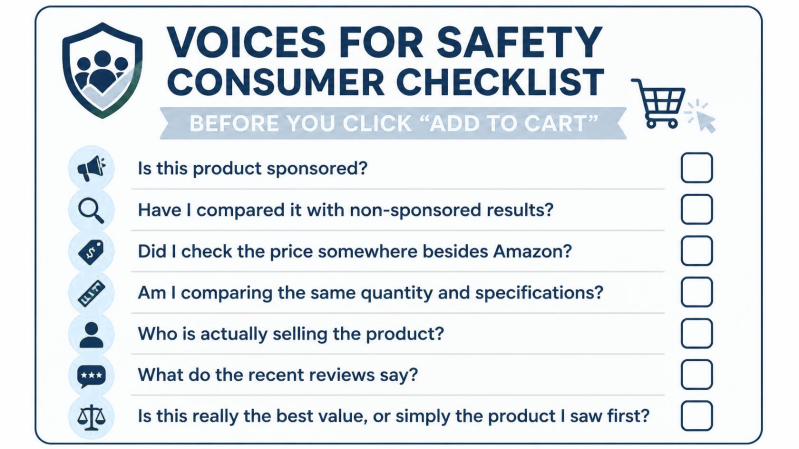
Try This the Next Time You Shop on Amazon
Let's turn this story into something useful.
The next time you search Amazon for a product, don't immediately click the first item.
Try this instead.
| STEP | DESCRIPTION | ACTION |
|---|---|---|
| 1 | Look for "Sponsored" | Notice which products are advertisements. You don't have to avoid them. Just recognize them for what they are. |
| 2 | Scroll | Yes, actually scroll. Look at several non-sponsored results too. Sometimes an excellent option is sitting a few rows below the products that paid for prime placement. |
| 3 | Compare the Actual Product | Look at: price, quantity, size, specifications, seller, shipping, return policy and recent reviews. A low advertised price can become less impressive when the quantity or specifications are different. |
| 4 | Leave Amazon for a Minute | This is one of my favorite consumer habits. Find the product somewhere else. Check: *the manufacturer's website, *another major retailer, *a local store, and *other reputable online sellers. |
| 5 | Then Make the Decision | After you've compared the actual choices, go back and buy whichever one genuinely makes sense. It may still be the sponsored product, and that's perfectly fine. The difference is that you chose it after comparing, rather than allowing advertising placement to make the first decision for you. |
There's a Bigger Story Here
This Amazon case fits into something I have been talking about repeatedly at Voices for Safety.
The digital marketplace is becoming increasingly difficult to see clearly.
- Personalized pricing.
- Paid search results.
- Sponsored products.
- Influencer and Affiliate marketing.
- Algorithmic recommendations.
- Subscription prompts.
- AI-generated advertisements.
- Retail media networks.
All of these systems can influence what you see before you ever consciously make a choice. And sometimes the most powerful persuasion is the persuasion we don't realize is happening.
That doesn't mean technology is bad. It doesn't mean advertising is bad. It means transparency matters. Consumers, overall, make better decisions when we understand why something is appearing in front of us.
There's Nothing Wrong With a Sponsored Product
This is worth saying clearly.
A sponsored product can be terrific. Small businesses use Amazon advertising. Independent sellers use it. Major brands use it. A company paying for advertising does not mean its product is inferior.
Just as buying an advertisement in a magazine doesn't tell you whether the advertised product is good or bad.
The real issue is understanding the distinction between:
advertising and recommendation
Those two words can look remarkably similar on a shopping page.
But they are not the same.
A Tiny Word Worth Noticing
Go back to Amazon sometime today and search for something. Anything.
- Coffee.
- Dog treats.
- Shampoo.
- Printer ink.
- A book.
Don't buy anything. Just look.
Notice how the page is constructed. Look for the word: Sponsored.
Once you start noticing it, you'll see online shopping a little differently. And that's not a bad thing. Because consumer protection doesn't always require another law, another app or another piece of technology.
Sometimes it starts with simply understanding what we're looking at.
Made with Canva AI
The FTC Case Is Just Beginning
The lawsuit filed August 31 is not a final judgment against Amazon. The FTC and 22 states have made serious allegations concerning Amazon's advertising auction practices.
- Amazon denies those allegations.
- Evidence will be presented.
- Arguments will be made.
- And the courts will ultimately determine whether Amazon violated the law.
Voices for Safety will continue watching the case.
But you don't have to wait for the final ruling to learn something useful from it. The next time you search for a product online, perhaps you should spend a few seconds looking beyond the first result placed in front of us. Because the first product we see may be there for several reasons.
- Quality may be one of them.
- Price may be another.
- Popularity may play a role.
And sometimes...
someone simply paid to put it there.
Speak Louder Than the Chaos
At Voices for Safety, I’m not here to tell you where to shop or what to buy. Instead, I want to help you get a good grip on the marketplace so you can make those choices on your own!
So, the next time you're shopping online, remember:
-
Sponsored doesn't mean bad.
-
But sponsored doesn't mean 'best', either.
Look beyond the placement.
Compare.
Ask questions.
Then decide where your money deserves to go.
That's informed shopping. And that's consumer protection.
Add comment
Comments