

Content by Wendy Busse-Coleman | Consumer-Protection Advocate and author, founder of Voices for Safety, Subscription Watch, and Clear Terms Press/Acorn Gold Press | I write about subscription traps, dark patterns, the fine print few people read, and, inspired by my granddaughter, short bedtime stories.
The Back Page | Blog | 2 Minute Read | November 14, 2026
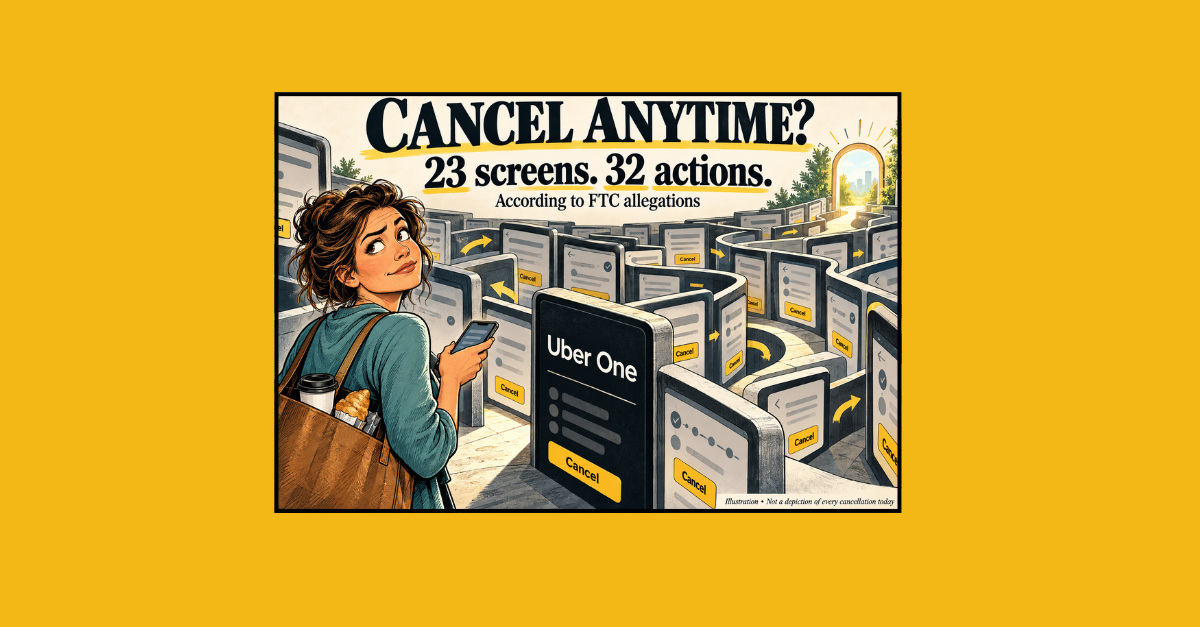
Quick question: how many screens should it take to cancel a subscription that promised you could cancel anytime? One? Two? Twenty-three sounds ridiculous. But that’s how many screens the FTC alleges some customers could face when trying to cancel Uber One.
OpenClassActions reports that a proposed class action was filed on October 1, 2026, and identifies it as Jesus v. Uber Technologies, Inc., No. 3:26-cv-11205. I haven’t independently verified the underlying court filings. I haven’t obtained and reviewed the private complaint, so I’m not describing its allegations firsthand.
The separate FTC case provides helpful public information to consider. While it doesn't reveal the details of the newer private complaint, we do know that the FTC took action against Uber in April 2025. They later updated the complaint in December 2025, with 21 states and the District of Columbia joining. Another update to the complaint followed in May 2026. While the allegations in the FTC’s publicly available complaint are intriguing and definitely worth examining, it's important to remember that they haven't been officially established yet.
The FTC alleges that Uber enrolled people and charged them without their consent, with key terms in small gray text that consumers could easily miss. The FTC also alleges that Uber’s advertised savings of about $25 a month didn’t subtract the subscription fee itself, which can be up to $9.99 a month. The complaint cites consumers who said they were charged before their free trials ended. And then came the exit.
Uber has always promised that you can “cancel anytime,” but navigating the cancellation process might not be as straightforward as it sounds. According to the FTC, it can involve going through up to 23 screens and completing 32 different steps, which can feel overwhelming. Some users have also had difficulty reaching customer support and reported being billed again even after requesting cancellation. While these details are outlined in the complaint, they don't reflect every cancellation experience today.
Twenty-three screens. Thirty-two actions. If that were your route out of a subscription, I'd call it a loyalty program for exhaustion.
Fairness matters to me, so here’s Uber’s response: In a December 2025 statement reported by Reuters, Uber denied enrolling customers or charging them without consent and said most cancellations took no more than 20 seconds. Uber also said its earlier requirement to contact support near renewal ended in December 2024.
If the process worked as the FTC alleges, “cancel anytime” came with a pretty exhausting catch. To me, that sounds less like convenience and more like a test of how badly someone wants to leave.
So what do you do with this? The same things I always tell you, because they work:
- Screenshot everything: the offer, the checkout screen, the "cancel anytime" promise.
- Save every confirmation email.
- Write down the date of your first cancellation attempt, because that date helps document the timeline. And don't let it all scatter across your camera roll and inbox. This is exactly why I built Subscription Watch: https://swatch.voicesforsafety.com.
- Every subscription you track gets its own vault, a dedicated place to store screenshots, confirmation emails, cancellation dates, and notes, so your evidence is organized and ready if you ever need to file a complaint or dispute a charge.
- It links you to the FTC's reporting site, where you can submit a complaint once your documentation is in order.
- If you run into trouble canceling or see charges you didn't authorize, you can report the experiences to the FTC and your state attorney general.
- And here's the hopeful part: documented complaints can help regulators identify recurring problems.
"Cancel anytime" shouldn't require a map, a snack, and a free afternoon.
What you can do today: stuck in a subscription you can't cancel? Document everything in your Subscription Watch vault (https://swatch.voicesforsafety.com), note the date of your first cancellation attempt, and follow the vault’s link to the FTC’s reporting site if you want to submit a complaint. Documented complaints can help regulators identify recurring problems.
Sources
Primary sources — FTC complaints: April 2025 complaint and subsequent amended filings in FTC v. Uber Technologies, Inc. These establish what the agency alleges, not that the allegations are proven.
FTC case record: https://www.ftc.gov/legal-library/browse/cases-proceedings/2423092-uber-ftc-v
Second amended complaint (May 2026): https://www.ftc.gov/system/files/ftc_gov/pdf/Uber-SecondAmendedComplaintwithRedactions.pdf
Reuters — December 15, 2025 reporting, including Uber’s dated response and its explanation of changes to cancellation near renewal:
Secondary reporting about the proposed private case — OpenClassActions:
The underlying private complaint and court filings have not been independently reviewed for this article.
Add comment
Comments