Voices in Action
Sources & Further Reading
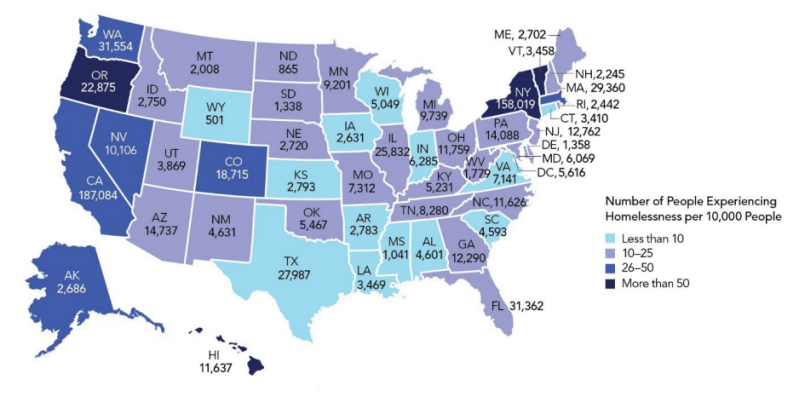
Homeless Population Data (HUD Point‑in‑Time Counts)
- HUD Annual Homelessness Assessment Report (AHAR) — State‑level 2024 PIT data for California, New York, Maryland, Oregon, and Washington.
-
HUD Exchange: PIT & HIC Data — Downloadable datasets for all Continuums of Care nationwide.
California
-
California State Auditor — Reviews of statewide homelessness spending and program performance.
-
California Department of Finance — Budget summaries for homelessness and housing programs (2022–2026).
New York
-
New York State Comptroller — Annual analysis of state and NYC homelessness spending.
-
HUD AHAR — New York State 2024 PIT Count.
Washington
-
Washington State Department of Commerce — 2025 Point‑in‑Time Count and statewide homelessness spending reports.
-
Washington State Standard — Coverage of the state’s 2025–27 housing and homelessness budget.
Oregon
-
Oregon 2025 Homelessness Report Card — Statewide spending, PIT data, and program outcomes (Portland State University + HUD references).
-
Oregon Housing & Community Services — State homelessness investments and emergency response funding.
Maryland
-
Maryland Department of Housing & Community Development (DHCD) — FY2026 operating budget and housing program allocations.
-
Maryland Continuum of Care PIT Count — 2024 statewide homelessness totals.
General Federal Sources
-
U.S. Department of Housing and Urban Development — National homelessness trends, methodology, and program funding details.
-
U.S. Interagency Council on Homelessness — Federal strategy documents and state‑by‑state comparisons.
📌 KNOW THE BASICS: What the NEA Was Created to Do
1. Support the Teaching Profession
The NEA’s original purpose was to elevate educators through training, standards, and professional development—not political advocacy.
2. Strengthen Academic Instruction
Its federally chartered mission centered on improving literacy, numeracy, and classroom quality so every child could master foundational skills.
3. Represent Educators, Not Ideologies
The NEA was intended to be a neutral, profession‑first organization focused on teaching and learning, not a political actor.
4. Keep Students at the Center
The core promise was simple: ensure teachers have what they need so students can succeed in reading, writing, and mathematics.

From urgent calls to action to moments of hope, this feed reflects the heartbeat of our community. These are the posts we're amplifying - because safety isn't a privilege - it's a promise we should all keep.





Federal Government Shutdown


Maryland's Governor Declares
State-of-Emergency
because of SNAP.
It's not just about numbers, it's about trust. When leaders ignore structural planning, they gamble with public services, safety nets, and taxpayer confidence.


Structural planning is a critical process that ensures the longevity and stability of a government’s budget. It extends beyond the objective of achieving a balanced budget for a single fiscal year, focusing instead on creating a sustainable financial framework that can endure over time without succumbing to the pressures of unsustainable expenditure.
A structurally sound budget does not use non-recurring revenues to fund recurring expenses. That's like using a holiday bonus to pay your monthly mortgage, it works once, but it's not sustainable.
When governments skip structural planning, they are often:
- Fund long-term programs with short-term money
- Create deficits when temporary revenue dries up.
- Face painful cuts or tax hikes to rebalance.
📞 How to Report Spoofed or Scam Calls
1. Federal Trade Commission (FTC)
• Go to the FTC Complaint Assistant.
• Select “Unwanted Calls” → “Phone Scams”.
• Provide the number (e.g., 410‑805‑1555), the date/time of the call, and any voicemail details.
• This helps the FTC track patterns and shut down abusive robocall operations.
2. Federal Communications Commission (FCC)
• File a complaint at the FCC Consumer Complaint Center.
• Choose “Phone” → “Unwanted Calls”.
• The FCC uses these reports to enforce rules around spoofing and robocalls.
3. National Do Not Call Registry
• Register your number at donotcall.gov.
• If you’re already registered, you can also report unwanted telemarketing calls there.
• While spoofed calls may still slip through, this reduces legitimate telemarketing traffic.
4. Carrier Call Protection Tools
• Most carriers (Verizon, AT&T, T‑Mobile, etc.) offer free or paid apps that block known spam numbers.
• Ask your carrier about STIR/SHAKEN technology, which authenticates caller IDs to reduce spoofing.
5. Local Awareness
• Share your experience with community groups, senior centers, or advocacy platforms like Voices for Safety™.
• Awareness is powerful — it helps others recognize the signs before they fall victim.
📌 Top 10 Lessons of 2025
A Voices for Safety™ Sidebar
1. Trust is a living thing — and it breaks quietly.
Whether it’s banking, policing, or politics, people don’t lose trust all at once. They lose it in small, preventable moments.
2. Technology can protect us… or trick us.
From spoofed calls to subscription traps, 2025 reminded us that “convenience” often comes with fine print.
3. Silence is not neutral.
When leaders stay quiet about harm — in Portland, Chicago, or anywhere else — communities pay the price.
4. Compassion is not weakness.
We can debate policy without dehumanizing people. We can disagree without destroying each other.
5. Scams evolve because people are overwhelmed.
The $152 subscription scam and the $25,000 insurance scam worked for the same reason: people are busy, tired, and trusting.
6. Misinformation doesn’t need a villain — just an editor.
A single “small change” can rewrite the truth. Accuracy matters more than ever.
7. Pop culture is never “just entertainment.”
Whether it’s a Super Bowl performance or a celebrity moment, the messages we amplify shape our values.
8. Policy made in panic rarely protects anyone.
Reactive lawmaking feels good in the moment but often creates long‑term harm.
9. Respect is not optional in a functioning democracy.
Protest is a right. Harassment is not. Passion doesn’t excuse cruelty.
10. We can’t fix what we refuse to face.
From immigration to shutdowns to community safety, progress starts with honesty — even when the truth is uncomfortable.